|
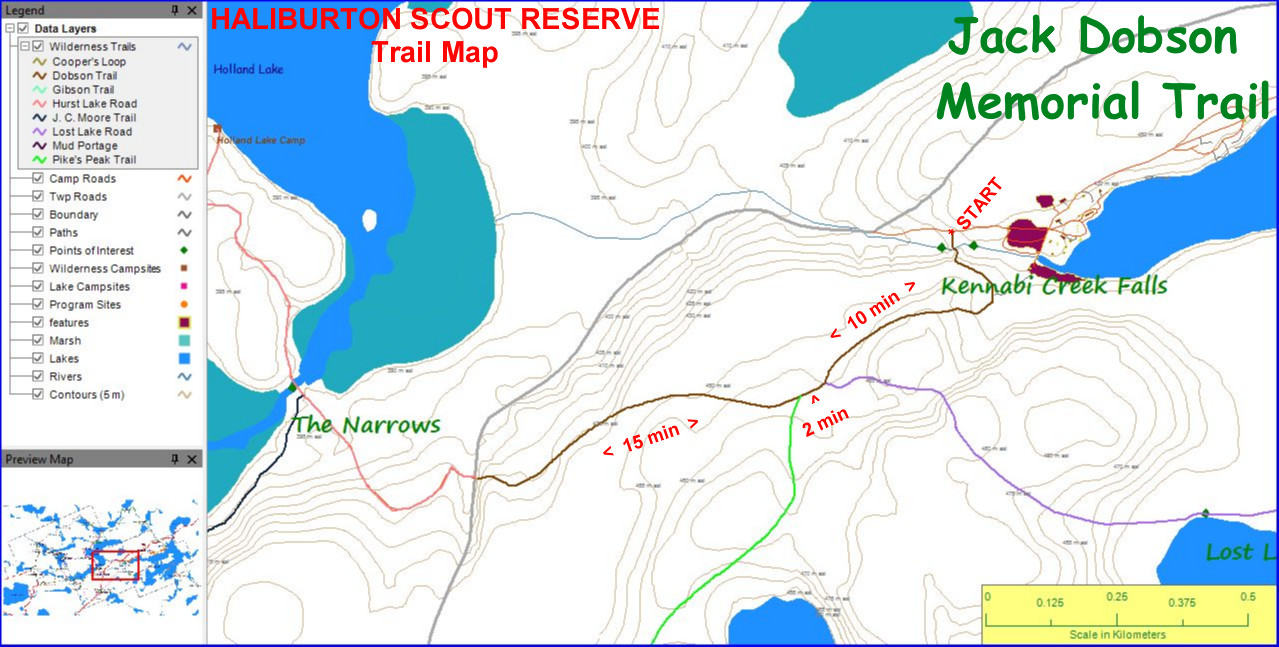
Description & Directions:
This trail is dedicated to the memory of
Jack Dobson who served the camp as
Ranger and Assistant from 1972-89. It
was designed to safely allow hikers to
reach the established trails without having
to use the Kennaway Road.
It starts just
west of the main parking lot along the
camp road. The new markers along this
trail will be yellow.
The trail leads down a couple of steps
from the left side of the road (as you
leave the parking area) to a wooden
bridge which crosses Kennabi Creek.
This creek flows from Kennabi Lake to
Holland Lake and at this point cuts
through the rock to form an impressive
series of waterfalls. This water is not
drinkable.
Just upstream from the bridge
are the remains of a hand-hewn wooden
dam and log chute which were used to
get the logs which had been cut during
the winter and left on the ice of Kennabi,
to Holland Lake, Drag River and eventually to Haliburton. In the dam, when examined carefully, you will notice large
spikes that held the wooden logs together
to hold back the water untill logs were collected at the edge of the dam. When a
quantity of logs were gathered, the dam
was opened and the logs flowed down
the river. This particular dam was built by
the Laking Lumber Company about 1906.
Please feel free to look but don't disturb
what's left so others can also see.
Cool and Damp - It is cooler and damper
down here and some of the evergreens
you see are hemlocks. They have short,
flat needles, and if you try to roll a single
needle between your thumb and forefinger, you can't, because it is flat. A spruce
needle is also short, but it is square, and
it rolls easily.
As you go by the creek
watch for the small clusters of dark green
polypody ferns among the rocks, and if it is August look down the creek from the
bridge for the scarlet spikes of Cardinal
flower, one of Ontario's most beautiful
flowers. In the wild, Cardinal flower only
grows in areas that are always wet, especially along shorelines. Unlike people it
loves to have its feet wet.
As you hike through the hemlocks, watch
for tiny yellow and black birds called
Black-Throated Green Warblers high up
in the hemlock trees (their nest can be up
to 80 feet above the ground), and listen
for the flute like calls of thrushes, especially early in the morning and around
dusk during May and June. Some people
believe the call of the Hermit Thrush is
the most beautiful sound in all of nature! It
is worth remembering, however that while
to us thrush songs are surpassingly beautiful, to the thrushes themselves their
songs are very serious business. As with
other songbirds, male thrushes use song
not only to attract a mate but also to
carve out and defend their territories
against other individuals of the same species. If any trespassers fail to heed the
musical warning, they will be attacked.
 The Old Kennaway Road - Across the
bridge, the trail turns left at the bottom of
a steep cliff and climbs at an angle to the
top. From here it heads south, then turns
west along the Old Kennaway Road
where it is joined from the left by the Lost
Lake Trail (which will be indicated with
new orange markers) at a small clearing. The Old Kennaway Road - Across the
bridge, the trail turns left at the bottom of
a steep cliff and climbs at an angle to the
top. From here it heads south, then turns
west along the Old Kennaway Road
where it is joined from the left by the Lost
Lake Trail (which will be indicated with
new orange markers) at a small clearing.
This road was actually built between 1865
and 1870 and until recently was the main
road through this area. It was built with
hand labour and primitive equipment and
was the main road between the Town of Haliburton and what was at one time the
Village of Kennaway. It was named for Sir
John Kennaway, the High Sheriff of Deonshire and a member of the Board of Directors of the Canadian Land and Immigration Company which purchased what
is now the County of Haliburton from the
Crown on May 9, 1865. In the summer of
1992, a Canadian dime dated 1876 was
found in the main parking area where this
road used to cross from what is now the
camp maintenance area.
About 50 metres further is another small
clearing from which the DT exits to the
right. (The old road which continues, is
the start of the Pikes Peak Trail which will
be indicated with new blue markers).
These junctions should be clearly signed
with both trail markers and routed signs.
The DT follows an old skid road down a
gentle slope then turns left and enters a
large clearing with tall grass which may
be a little confusing. The trail heads
straight across the field (west) but turns
right before reaching the other side and
leaves the clearing on the north side.
This area has been logged recently. Nobody really likes to see areas like this,
because they are ugly ompared to the
majestic forest that used to be here. But
trees provide us with valuable materials
for our houses and furniture, and go into
paper that we all use. In addition, they
provide many people in Ontario with jobs
and salaries. If we are careful, we can
have both forests and the valuable products and incomes that trees provide. But
we have to be careful!
As you walk through the thick raspberry
cane in the logged areas, watch and listen for White Throated Sparrows, whose
whistled call has earned it the nickname
of "O Canada" bird. To many people, this
sound reminds them of the Ontario wilderness. And if you are lucky enough to
be hiking this trail when the raspberries
are ripe, try eating one before the birds
get them all!
Beech Trees and Bears - At the far end
of the open area, watch for a tree with a
very wide trunk, and a smooth greyish-blue bark that looks like the skin of an
elephant. This is a Beech tree. It is not a
valuable tree for lumber because older
beech trees that are big enough for a
sawmill are usually hollow, and don't
make good lumber. They make very good
firewood, however, and are very valuable
for wildlife if they are left standing. Birds,
like Blue Jays, and animals such as squirrels relish the nuts that beech trees make.
Look carefully at the sides of this beech
tree in particular. See if you can pick out
the sets of marks that run up each side of
the tree. They are the claw marks of a
bear that long ago climbed this tree looking for beech nuts. Because of their
smooth bark, beech trees often show
bear claw marks.
From here the trail descends toward the Kennaway Road road through a beautiful mature deciduous forest dominated by sugar maples and yellow birch trees. The biggest
of these trees represent some of the largest and oldest maple in Ontario, ranging
up to just under a meter in diameter, and
could be as old as 150 to 200 years old.
You can tell that these trees won't get
much bigger than this, because from time
to time, you can see the big trunks of
dead maples which are about the same
size. These giants have lived out their
lives and have died from natural causes.
Take care when crossing the Kennaway Road as
the trail meets the road on the inside
of a wide curve! Drivers can't see you, but you should be able to hear them, IF you pay attention to your surroundings.
The stream here is Wallace Creek which
flows into Holland Lake. This water is
not drinkable.
|


.JPG)
 (2).jpg)
.jpg)